

The mobile phone industry in 2026 has reached a defining moment where minor upgrades no longer impress. Instead, flagship smartphones have evolved into professional-grade creative tools, prioritizing photography, videography, and performance over basic communication. While computational video dominates industry headlines, the real winners are ultimately chosen by users—those who best translate innovation into real-world creative power.
The Xiaomi 16 Ultra vs. Oppo Find X9 Pro showdown pits two technological powerhouses against each other, representing radically different visions of the future. Both devices push the boundaries of what a pocket-sized flagship can achieve, setting new benchmarks in mobile engineering and camera innovation.
Design and Build: Tactile Luxury vs. Modular Versatility
Both smartphones project a premium flagship presence at first glance, yet their design philosophies diverge sharply in terms of ergonomics and creative intent. The Xiaomi 16 Ultra continues the brand’s iconic camera-centric design language, emphasizing form that directly supports photography and videography.
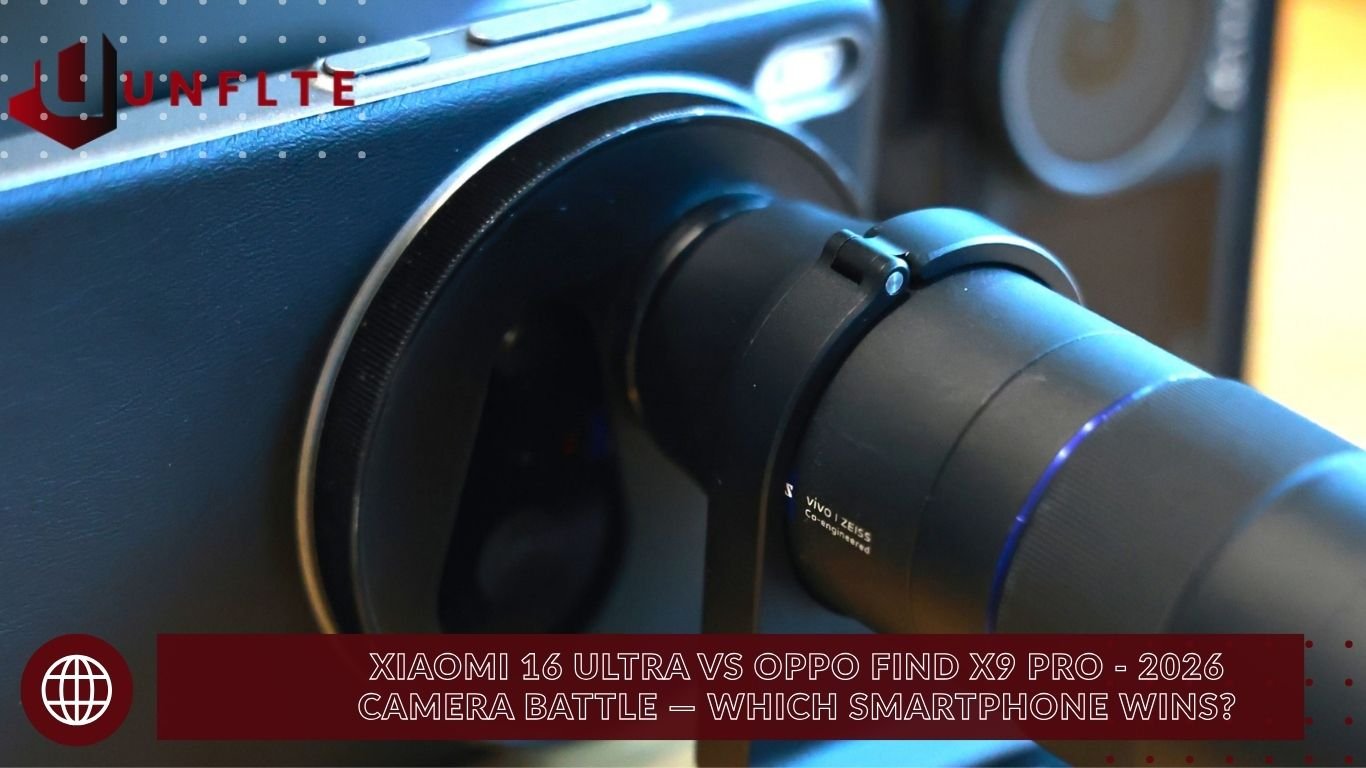
Its standout feature is a rotating camera bezel that surrounds the oversized lens module. This isn’t a visual gimmick—it enables manual zoom control and focus pulling with precise mechanical haptic feedback, delivering a tactile experience that closely mirrors a DSLR camera. Complementing this functionality, the rear panel is finished in a new bio-ceramic material that resists scratches while offering a refined, leather-like texture for improved grip and durability.
The Oppo Find X9 Pro embraces a minimalist Seamless Flow design philosophy. Its smooth glass back and gently curved frame eliminate sharp edges, resulting in a device that feels effortlessly balanced in the hand. The true innovation lies beneath the rear branding: a discreet Magnetic Accessory Port.
This port supports Oppo’s new Hasselblad Telephoto Kits, allowing users to attach external optical lenses via a secure magnetic clip. These modular accessories significantly extend optical zoom capabilities, positioning the Find X9 Pro as a flexible, future-ready camera system rather than a fixed-lens smartphone.
Technical Specification and Price Comparison
To clearly evaluate the strengths and overall value of the Xiaomi 16 Ultra vs Oppo Find X9 Pro, it’s important to compare their core hardware specifications and market pricing in India:
| Feature | Xiaomi 16 Ultra | Oppo Find X9 Pro |
| Main Sensor | 1-inch Sony LYT-900 | 1/1.12-inch Custom Sensor |
| Special Hardware | Haptic Rotating Bezel | Magnetic Hasselblad Mount |
| Display | 6.8″ Quad-Curved (4500 nits) | 6.8″ Micro-Curved (4000 nits) |
| Processor | Snapdragon 8 Gen 5 + Surge T2 | Dimensity 9500 + MariSilicon X3 |
| Video Standard | 8K 60fps (Cinema Grade) | 8K 60fps (Ultra XDR) |
| Battery / Charge | 6,000mAh / 120W Wired | 7,500mAh / 80W Wired |
| Launch Price (India) | ₹1,19,990 (Expected) | ₹1,09,999 (Official) |
| Software Promise | 4 Years OS / 5 Years Security | 5 Years Full OS & Camera Algo |
Show Performance: The Battle of 4,000 Nits
By 2026, display quality will no longerbe defined by resolution alone. Visibility, eye comfort, and long-term visual health have become equally important. Both smartphones feature identical 6.8-inch LTPO 4.0 AMOLED displays, yet each brand prioritizes different display strengths.
Xiaomi 16 Ultra focuses on extreme brightness and visual precision. It utilizes advanced C9 luminescent material, enabling an industry-leading peak brightness of up to 4,500 nits. The phone features a striking quad-curved, near bezel-less display that enhances immersion. Paired with 12-bit color depth, the panel works seamlessly with computational video processing to reproduce colors exactly as captured by the camera sensor, ensuring professional-grade visual accuracy.
On the other hand, the Oppo Find X9 Pro centers its display strategy around visual comfort and eye protection. While still delivering an impressive 4,000 nits of peak brightness, it introduces an ultra-high 3840Hz PWM dimming rate, effectively eliminating screen flicker at low brightness levels. Its refined micro-curved display design combines the elegant look of curved glass with the durability and accidental-touch resistance typically associated with flat panels.
The Battle of the Cameras: Sensors vs. Optics
This is the defining moment for photography purists. Both brands confidently claim that nearly 90% of professional DSLR use cases can now be replaced by advanced smartphone cameras. In the Xiaomi 16 Ultra vs Oppo Find X9 Pro camera comparison, it is the hardware-first approach that ultimately shapes the user experience.
Xiaomi 16 Ultra is built for creators who value pure image data and manual control. Its massive 1-inch Sony LYT-900 sensor remains unmatched for capturing rich dynamic range and natural depth. Integrated Focus Peaking, controlled directly through the rotating camera bezel, is a feature typically reserved for high-end mirrorless systems. This setup excels in street photography and portrait work, delivering authentic, optical natural bokeh that smaller sensors cannot replicate.
The Oppo Find X9 Pro, meanwhile, dominates in photographic versatility and reach. Its advanced periscope telephoto system already sets a high standard, but when paired with the optional Hasselblad Telephoto Kit (priced at ₹29,999), the phone delivers a true 10x optical zoom. For sports, wildlife, and long-distance photography, Oppo offers a level of optical flexibility that Xiaomi cannot match due to its fixed internal lens configuration.
Battery, Charging, and Sustainability
Oppo makes a compelling statement in the long-term usability and endurance segment. In the Xiaomi 16 Ultra vs Oppo Find X9 Pro longevity comparison, the Find X9 Pro stands out with a confirmed five-year software support commitment, ensuring regular security updates and camera algorithm enhancements through 2031. This long-term support is complemented by 80W fast charging, which efficiently replenishes its massive 7,500mAh battery for extended daily use.
Xiaomi counters with cutting-edge battery technology. The Xiaomi 16 Ultra features a 6,000 mAh silicon-carbon battery, which is significantly thinner and more energy-dense than traditional lithium-ion cells. While its 120W wired fast charging surpasses Oppo in raw speed, Xiaomi truly leads in convenience with an industry-first 80W wireless charging system, making cable-free charging a practical, everyday reality.
Frequently Asked Questions
Which smartphone has the better camera in 2026: Xiaomi 16 Ultra or Oppo Find X9 Pro?
Both excel in different areas. The Xiaomi 16 Ultra delivers superior image quality with its 1-inch sensor, while the Oppo Find X9 Pro offers unmatched zoom versatility with its modular telephoto system.
Does the Xiaomi 16 Ultra truly replace a DSLR for photography?
For most scenarios, yes. Its large Sony LYT-900 sensor, natural bokeh, and manual controls replicate many DSLR use cases, especially for street and portrait photography.
What makes the Oppo Find X9 Pro camera unique?
The standout feature is the optional Hasselblad Telephoto Kit, which adds true 10x optical zoom, making it ideal for sports, wildlife, and long-distance photography.
Which phone is better for video recording and content creators?
Xiaomi 16 Ultra appeals more to video creators due to its manual focus controls, focus peaking, and color accuracy, while Oppo focuses on stabilized long-range video capture.
Are both phones suitable for professional photography work?
Yes. Both devices are designed as professional-grade creative tools, capable of handling commercial photography, social media content, and advanced video production.
How do the displays compare between Xiaomi 16 Ultra and Oppo Find X9 Pro?
Both feature 6.8-inch LTPO AMOLED displays, but Xiaomi prioritizes peak brightness, whereas Oppo emphasizes eye comfort with high-frequency PWM dimming.
Which smartphone offers better long-term software support?
Oppo Find X9 Pro has the advantage with a promised five-year software support policy, ensuring updates and security patches through 2031.
Conclusion
The Xiaomi 16 Ultra vs Oppo Find X9 Pro showdown proves that the 2026 smartphone camera race is no longer about megapixels alone—it’s about creative intent and user priorities. Xiaomi positions the 16 Ultra as a pure photography powerhouse, delivering DSLR-like control, a massive 1-inch sensor, and unmatched wireless charging convenience. It’s the ideal choice for creators who value manual control, natural bokeh, and cinematic precision.
