

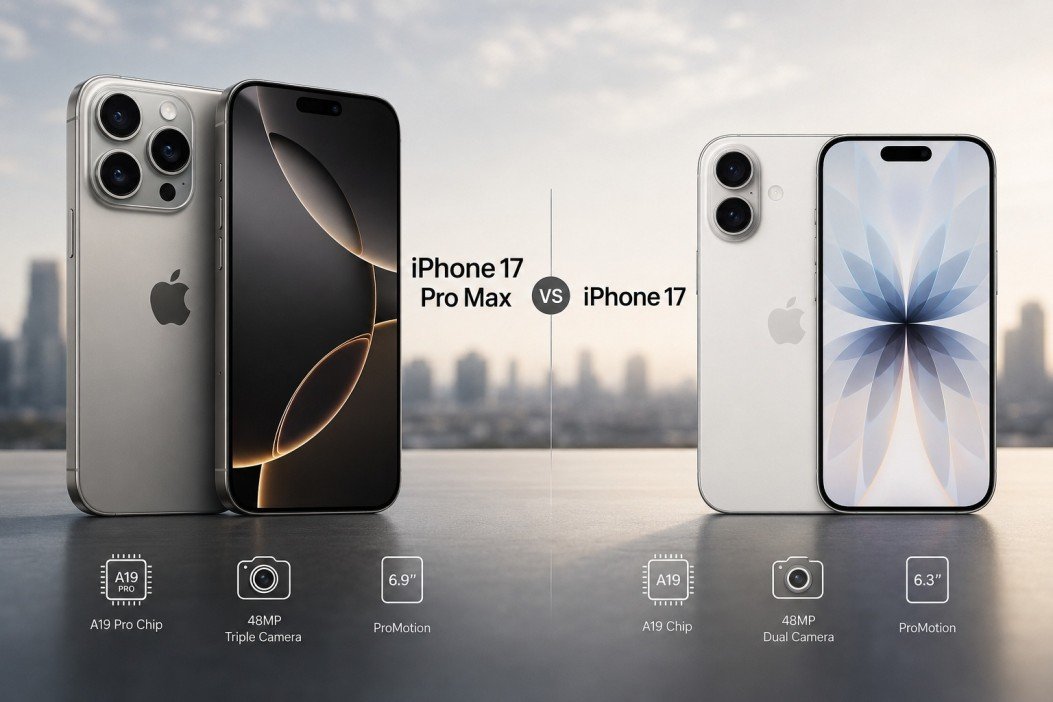
The modern premium smartphone market has entered an era where choices are dictated by architectural purpose rather than minor, iterative upgrades. For years, the selection process between a standard mobile device and its top-tier counterpart was defined by simple screen-scaling and marginal battery adjustments. Today, cellular engineering separates hardware tiers by computational sustainability, optic volume, and data-routing infrastructure.
The newest generation of mobile devices highlights this technical divide. At one end of the design spectrum is the flagship iphone 17 pro max, an uncompromised pocket-sized workstation built for sustained multi-stream creative production. At the other sits the iPhone 17, a refined baseline device that redefines what a standard model can achieve. Analyzing the core internal mechanics, material compositions, and underlying design philosophies of these two devices outlines how mobile hardware adapts to different professional and personal workflows.
1. Internal Architectures: A19 Pro Silicon vs. Standard A19 Power
The fundamental point of comparison between these two models begins with the silicon packages buried beneath their glass and metal enclosures. While both chips share advanced 3-nanometer semiconductor fabrication nodes, their operational limits and computing configurations serve completely different workloads.
The Heavy-Duty Workstation Chip
The iphone 17 pro max runs on the advanced A19 Pro system-on-chip (SoC), configured with a 6-core CPU and a fully unlocked 6-core GPU. Every graphical core includes integrated Neural Accelerators designed to handle real-time physics and advanced light modeling natively. Supported by a massive 12GB baseline of unified system memory, this flagship layout effortlessly executes complex on-device generative AI models, locally processes large machine learning frameworks, and manages extensive multitasking parameters without memory clearing.
The Everyday Performance Engine
The standard iPhone 17 is driven by the base A19 processor, paired with 8GB of dedicated system memory. The system architecture utilizes a 6-core CPU matched with a slightly trimmed 5-core GPU. While it lacks the raw graphical core counts found in the Pro tier, it still features dedicated Neural Accelerators across its GPU framework alongside a robust 16-core Neural Engine. This configuration delivers an incredibly responsive, snappy experience for everyday multi-tasking, high-framerate gaming, and standard application routing while preserving overall energy efficiency.
2. Thermal Dynamics and Performance Sustainability
Raw computing specifications only tell half the story. The true indicator of premium hardware capability is the device’s ability to sustain peak performance over long periods without dropping frame rates or overheating.
-
Flagship Vapor Chamber Loop: To prevent thermal throttling during heavy digital production cycles—such as exporting uncompressed 4K video timelines—the iphone 17 pro max introduces a hermetically sealed internal vapor chamber cooling system built directly into its unibody frame. A microscopic drop of deionized water cycles continuously between liquid and gas states within laser-welded copper channels, pulling heat rapidly away from the A19 Pro SoC and spreading it evenly across the outer chassis. This system yields a 40% improvement in sustained performance over previous generations.
-
Standard Graphite Dissipation: The standard iPhone 17 continues to manage its thermal footprint through traditional high-efficiency internal graphite sheets. Because its 5-core GPU produces lower sustained thermal output during everyday use, this passive arrangement keeps the device running cool during bursts of high-performance activity. However, it is optimized for rapid cooling rather than hours of continuous high-load processing.
3. Screen Evolution: Real Estate and Display Technology Parity
The latest device generation introduces a highly anticipated milestone: premium display parity. The era of reserving smooth, high-refresh-rate viewing experiences exclusively for the expensive pro models has officially ended.
Both screens feature Super Retina XDR OLED technology protected by advanced Ceramic Shield 2 armor, which provides three times greater scratch resistance than preceding display glasses. Outdoor visibility is exceptionally clear across both models, with peak brightness capabilities reaching an impressive 3,000 nits under direct sunlight.
The primary difference lies in the available physical real estate. The standard iPhone 17 steps up to a larger 6.3-inch canvas with slimmed-down physical bezels. Meanwhile, the iphone 17 pro max moves to a massive 6.9-inch diagonal display footprint, establishing the largest, most immersive workspace ever engineered for a mobile device. Thanks to the integration of adaptive LTPO backplanes, both layouts support fluid ProMotion refresh rates ranging from 1Hz to 120Hz, bringing ultra-smooth animations and power-saving Always-On display capabilities to the entire lineup.
4. Optical Engineering: The Triple-Lens Plateau vs. Dual Fusion Arrays
Camera hardware remains one of the clearest differentiators between everyday premium smartphones and high-end creative equipment.
The Pro Master Class Array
The back panel of the iphone 17 pro max features a prominent “plateau camera” bump. This architectural layout provides the physical depth required to house three separate, high-resolution 48-megapixel sensors covering Main, Ultra-Wide, and Telephoto focal lengths.
By utilizing a unique 4x tetraprism optical glass configuration and advanced software-driven sensor crops, the system delivers an uncompromised 8x optical-quality zoom. Content creators can capture cinema-grade ProRes video at 4K at 120 frames per second, log footage in Apple Log 2, and connect external storage devices to save data instantly over high-speed interfaces.
The Capable Dual Fusion Setup
The standard iPhone 17 features a streamlined, flat dual-lens rear camera configuration. It replaces the old 12MP ultra-wide component with an upgraded 48-megapixel Fusion ultra-wide sensor alongside its 48-megapixel primary camera.
While it lacks a dedicated physical telephoto lens, the high-resolution main sensor utilizes intelligent pixel-binning and advanced software pipelines to deliver 1x and 2x optical-quality zoom profiles. This setup provides clean macro photography and excellent image consistency across various lighting conditions, making it an agile choice for standard everyday documentation.
5. Mobile Data Management, Power Networks, and Physical Security
Modern connectivity requires robust security frameworks and efficient power management. Both devices include Memory Integrity Enforcement (MIE), an advanced, always-on hardware-level defense system that uses secure memory allocators and synchronous memory tagging to block complex security exploits and safeguard private user data.
For network connections, both models feature the advanced, Apple-designed N1 networking chip, which natively supports Wi-Fi 7, Bluetooth 6.0, and Thread home integration. However, their data interfaces and charging speeds show key differences:
-
I/O Transfer Speeds: The standard iPhone 17 uses a traditional USB 2.0 protocol over its Type-C port, capped at 480Mbps. The iphone 17 pro max utilizes a high-bandwidth USB 3.2 connection capable of hitting blistering 10Gbps transfer rates, making light work of moving massive files to computers or external storage pools.
-
Battery Capacities and Power Delivery: The larger chassis of the flagship model houses a massive battery that offers up to 33 hours of continuous video playback. The standard model contains a highly efficient battery pack that yields a respectable 30 hours of runtime. Both models support upgraded, faster 40W wired charging speeds, allowing users to replenish 50% of their battery capacity in just 20 minutes when connected to a compatible high-wattage charging adapter.
6. Sourcing and Protecting Your Premium Smartphone Investment
Deciding between the everyday balance of the standard model and the heavy-duty capabilities of the flagship depends entirely on your daily production needs and workflow demands. If your tasks require a massive display canvas, uncompromised optical zoom reach, and heavy data transfer speeds, the top-tier model stands out as an exceptional professional investment. If your priorities center on excellent daily battery life, smooth system animations, and reliable multi-tasking performance in a lighter frame, the standard model offers incredible value.
Regardless of which layout aligns with your personal or business goals, making your purchase through a certified Apple Premium Partner ensures your digital investment remains fully protected. Sourcing devices through authorized regional showrooms guarantees access to official regional configurations, authentic global product warranties, and a dedicated service infrastructure. Furthermore, working with platform-certified experts lets you take advantage of competitive trade-in programs, explore low-interest structured installment plans, and access genuine replacement parts to keep your device running perfectly throughout its multi-year operational lifecycle.
