

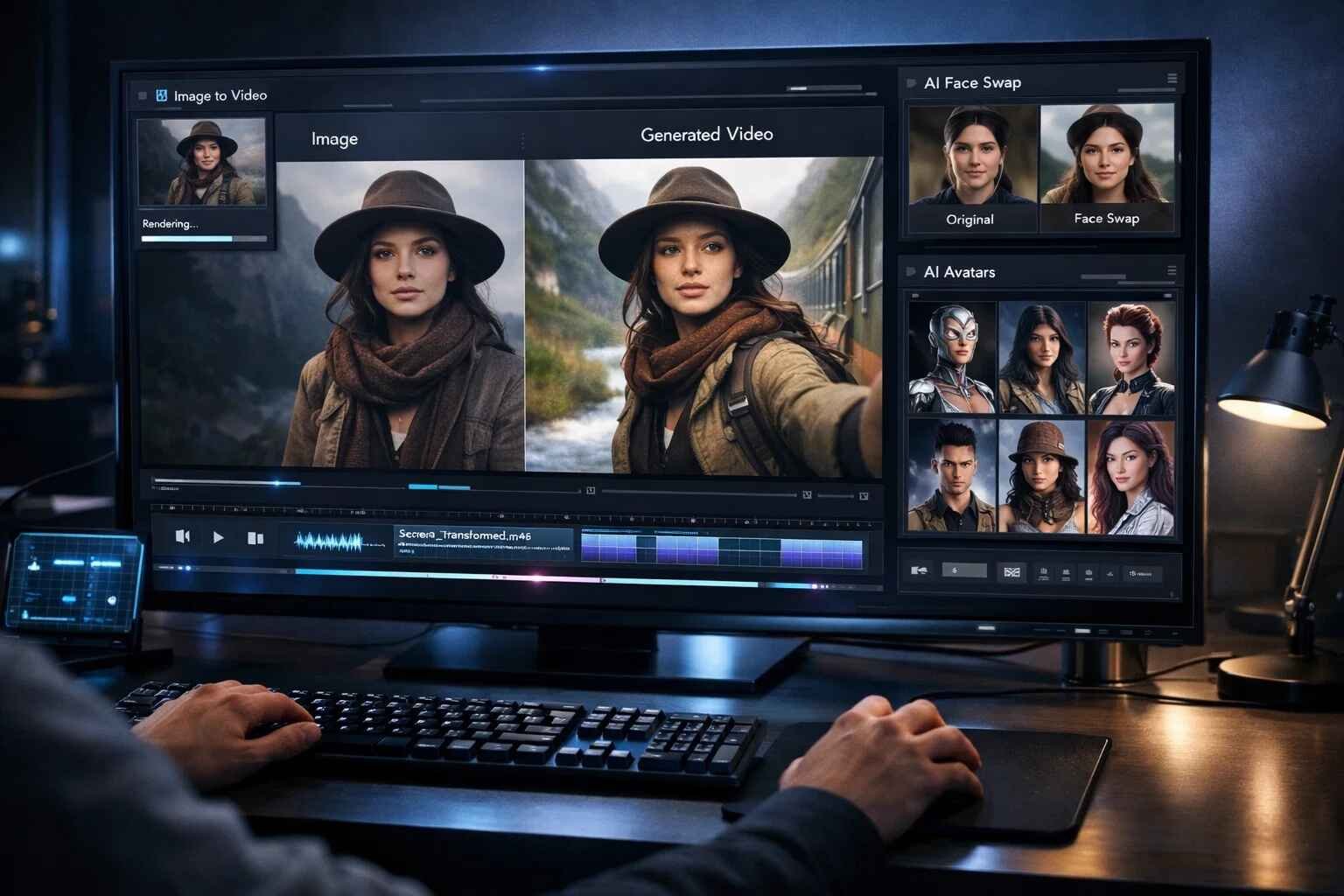
As of 2026, the fastest way to improve content performance isn’t better editing—it’s better generation. After spending weeks testing tools across workflows, I can confidently say this: the best AI image to video generator platforms are no longer experimental—they’re production-ready.
At the same time, face swap technology has matured into something far more practical than viral gimmicks. Today’s tools power ad creatives, product demos, and even localized campaigns.
If you’re building content at scale, you need tools that are fast, flexible, and actually usable under pressure. I tested the leading platforms to find out which ones deliver.
I guarantee at least one of these tools will meet your needs.
Best AI Tools at a Glance (2026)
| Tool | Best For | Core Features | Platforms | Free Plan |
| Magic Hour | All-in-one AI video creation | Image-to-video, face swap, lip sync | Web | Yes |
| Runway | Creative professionals | Gen-2 video, motion tools | Web | Limited |
| Pika Labs | Social media creators | Prompt-based video generation | Web/Discord | Yes |
| Synthesia | Business videos | AI avatars, voiceovers | Web | No |
| HeyGen | Marketing teams | Face swap, avatars | Web | Limited |
| Kaiber | Artistic visuals | Stylized animations | Web | Yes |
| D-ID | Talking avatars | Photo animation | Web | Limited |
1. Magic Hour — Best Overall AI Image to Video Generator & Face Swap Platform
If you’re serious about AI-driven video creation, Magic Hour is the most complete platform I tested.
What stood out immediately is how seamlessly it combines multiple workflows—image-to-video, face swap, and lip sync—into a single interface. Most tools specialize. Magic Hour integrates.
For example, their AI image to video generator lets you turn static visuals into dynamic clips with minimal effort. You can go from concept to usable content in minutes.
Even more impressive is the Magic Hour video face swap feature. It’s fast, accurate, and actually usable for marketing—not just entertainment.
If you’re exploring tools like image animation or automated editing, their image to video ai workflow feels production-ready, not experimental.
Pros:
- Extremely fast generation times
- High-quality output suitable for ads
- Multiple tools in one platform
- Strong face swap accuracy
- Clean, intuitive UI
Cons:
- Advanced customization could go deeper
- Some features still evolving
My Take:
After testing everything, this is the tool I’d recommend to most creators and teams. It balances power and usability better than anything else I’ve used.
If you want a single platform that handles everything from face swap ai workflows to full video generation, this is hard to beat.
Pricing:
- Free plan available
- Paid tiers for higher resolution and usage
2. Runway — Best for Advanced Creative Control
Runway remains one of the most respected names in AI video.
Their Gen-2 model produces high-quality outputs, especially for abstract or cinematic visuals. However, it leans more toward creative experimentation than practical marketing workflows.
Pros:
- Strong visual quality
- Advanced editing tools
- Frequent updates
Cons:
- Steeper learning curve
- Slower workflow compared to competitors
My Take:
If you’re a creative professional or filmmaker, Runway gives you more control. But for speed and scalability, it’s not as efficient as Magic Hour.
Pricing:
- Free tier available
- Paid plans for extended usage
3. Pika Labs — Best for Fast Social Content
Pika Labs is one of the fastest-growing tools in this space.
It’s built for speed. You type a prompt, and it generates a video quickly—ideal for social media content.
Pros:
- Very fast generation
- Easy to use
- Great for short-form content
Cons:
- Limited control over output
- Quality can vary
My Take:
If you need quick TikTok or Instagram content, Pika works well. But for structured campaigns, it lacks depth.
Pricing:
- Free access with limitations
4. Synthesia — Best for Corporate Video Production
Synthesia focuses on AI avatars for business use cases.
It’s widely used for training videos, onboarding, and internal communications.
Pros:
- Professional avatar quality
- Strong enterprise features
- Reliable output
Cons:
- Limited creative flexibility
- Not ideal for dynamic content
My Take:
Great for structured, corporate environments—but not for creative campaigns or ad testing.
Pricing:
- Paid plans only
5. HeyGen — Best for Avatar & Face Swap Content
HeyGen sits somewhere between Synthesia and Magic Hour.
It offers avatars and face swap capabilities, but the experience isn’t as fluid.
Pros:
- Good avatar system
- Decent face swap tools
Cons:
- Slower workflow
- Less integrated features
My Take:
A solid option, but if face swap is your priority, Magic Hour is noticeably ahead.
Pricing:
- Limited free plan
- Paid tiers available
6. Kaiber — Best for Stylized Video Content
Kaiber is built for visual storytelling.
It excels at transforming images into stylized, animated videos.
Pros:
- Unique artistic outputs
- Easy to use
Cons:
- Not ideal for commercial use
- Limited control
My Take:
If you’re creating music videos or artistic visuals, Kaiber is fun. For business use, it’s less practical.
Pricing:
- Free and paid options
7. D-ID — Best for Talking Photos
D-ID specializes in animating still images into talking avatars.
Pros:
- Simple workflow
- Good for presentations
Cons:
- Limited beyond talking heads
- Less dynamic output
My Take:
Useful for specific cases, but not a full video solution.
Pricing:
- Limited free usage
How I Chose These Tools
I didn’t rely on feature lists—I tested everything hands-on.
Here’s what I evaluated:
- Output quality
- Speed of generation
- Ease of use
- Real-world usability (ads, content, marketing)
- Flexibility across workflows
I also looked at how well each platform supports ai image editor workflows and integrates with broader content pipelines.
The biggest differentiator?
How quickly you can go from idea to publishable content.
Market Trends in AI Video (2026)
This space is moving fast, but a few trends are clear:
1. All-in-One Platforms Are Winning
Tools that combine image to video, lip sync ai, and face swap are replacing single-purpose apps.
2. Speed Is the New Advantage
Teams are prioritizing tools that generate content in minutes, not hours.
3. Personalization at Scale
AI now allows multiple variations of the same video for different audiences.
4. Editing Is Becoming Prompt-Based
The rise of ai image editor with prompt free workflows shows where things are heading—less manual work, more automation.
Final Takeaway
If you’re deciding quickly, here’s the breakdown:
- Best overall: Magic Hour
- Best for creatives: Runway
- Best for quick content: Pika Labs
- Best for business videos: Synthesia
But here’s the bigger point:
The advantage no longer comes from creating one great video—it comes from creating many, testing fast, and iterating.
That’s why platforms like Magic Hour stand out. They don’t just generate content—they enable strategy.
FAQ
What is the best AI image to video generator in 2026?
Magic Hour is currently the most balanced option, combining speed, quality, and multiple features in one platform.
Are AI face swap tools safe to use?
Most reputable platforms include safeguards, but always follow ethical and legal guidelines when using face swap technology.
Can I use these tools for marketing campaigns?
Yes. In fact, many tools are now optimized for ads, social content, and conversion-focused creatives.
Do I need editing experience to use these tools?
No. Most platforms are beginner-friendly, especially those with prompt-based workflows.
How fast can I generate videos?
Depending on the tool, anywhere from a few seconds to a few minutes.
